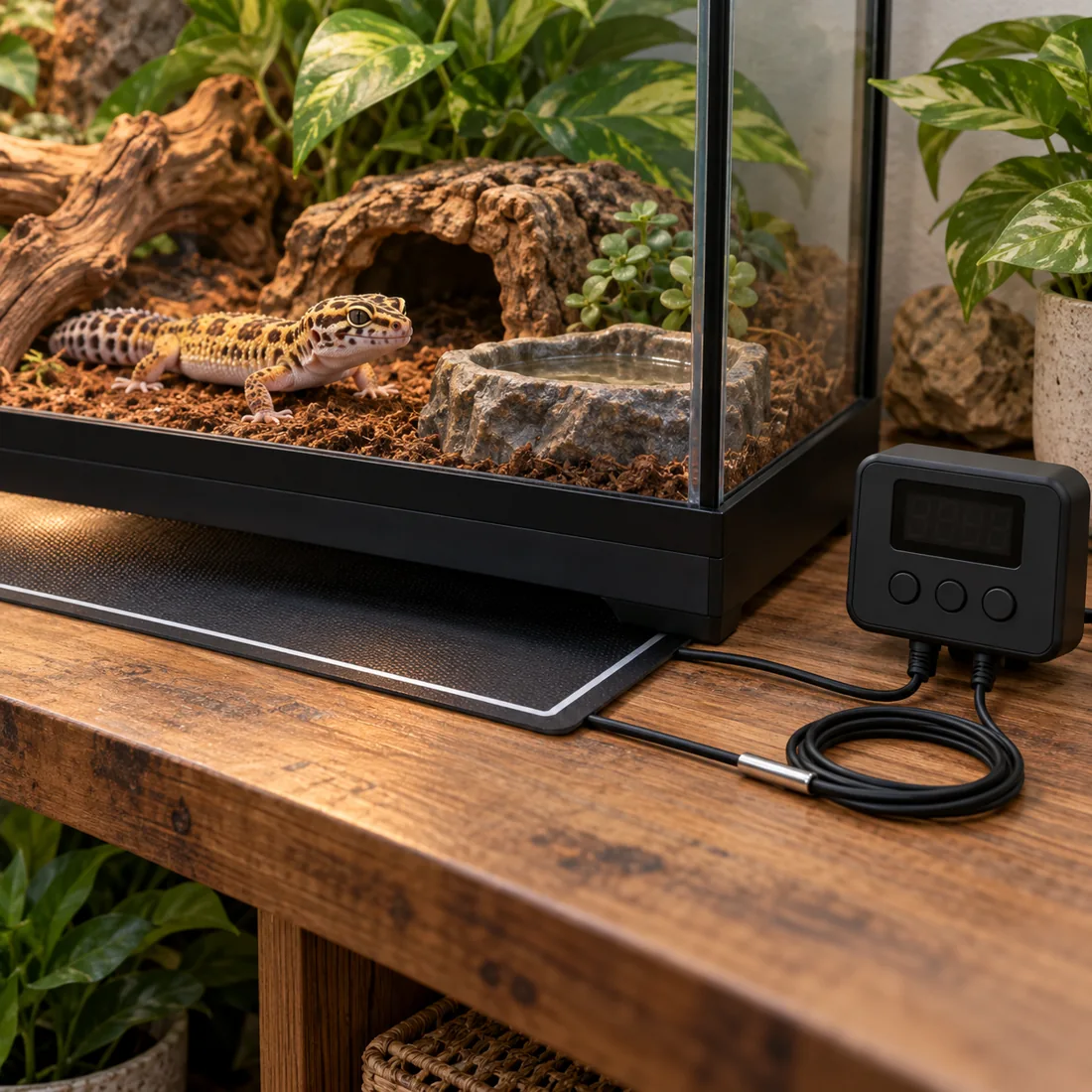
Three thermostat classes
Herpstat 1 / proportional reptile thermostat
Spyder Robotics documents proportional heating, soft startup, calibration and programmable behavior. This is the serious-control option when the heater should be modulated instead of simply clicked on and off.
Buy it when: you run a deep heat projector, radiant heat panel or want high-end temperature management
Watch for: higher upfront cost and configuration is more involved than a plug-and-play thermostat
Inkbird ITC-306T
INKBIRD lists dual heating outlets, day/night set points, calibration, alarms and a 10A heating output. That feature set makes it useful for simple heat-mat control when used within its ratings.
Buy it when: you are controlling one or two heating-only devices such as supplemental mats
Watch for: it is heating-only on/off control, not a dimming thermostat
Reptile heat-mat thermostat controller
A basic thermostat is vastly safer than plugging a mat directly into the wall, but this is one category where saving ten dollars on unknown hardware is not especially compelling.
Buy it when: you need a straightforward controller for a small supplemental mat
Watch for: quality and probe reliability vary widely among generic brands
Probe placement is the control loop
A thermostat controls only what its probe tells it. For a heat mat supporting a warm hide, place the probe where the animal actually experiences the regulated warmth according to the care plan, then independently verify with a separate thermometer. Do not tape a probe in a place the reptile can drag, bury or pin against a hotter surface.
Why heat mats are now usually supplemental
Current higher-welfare guidance for leopard geckos, ball pythons and corn snakes increasingly favors overhead daytime heat because it warms surfaces and air more naturally. A heat mat can still help a warm hide or specific supplemental need, but it should not become an excuse to keep the entire room air too cold.
On/off vs dimming
On/off thermostats maintain a band around the set point by switching power. Proportional controllers make smaller output changes. That smoother behavior is why proportional control is recommended for deep heat projectors and radiant panels. The exact control mode must match the heater and manufacturer instructions.
Redundancy is not overkill
The thermostat display is not your independent thermometer. Use a separate digital probe at animal level and a temperature gun for basking surfaces. If those readings disagree materially with the thermostat, stop and diagnose the probe placement or calibration.
The part that matters more than the product name
Measure the enclosure, not the marketing label
“40 gallon,” “120 gallon,” and similar labels are convenient shorthand, but reptiles experience length, width, height, ventilation and usable surface area. Two tanks with the same nominal volume can create completely different thermal gradients. Before you buy a heater, lamp or enclosure accessory, write down the actual internal dimensions and the distance from the animal’s highest usable basking surface to the lamp.
Build the gradient before adding the animal
A good reptile setup offers choices. The warm end should be meaningfully warmer than the cool end, humidity should be appropriate to the species rather than uniform everywhere, and the animal should be able to move into shade. Run the enclosure empty for several days, log temperatures at animal level, and change wattage, lamp height or ventilation before the reptile moves in.
Use instruments, not your hand
Human skin is a poor reptile thermometer. Use digital probe thermometers for ongoing air or hide measurements and an infrared temperature gun for surfaces. If you are dialing in UVB, lamp output is affected by fixture, mesh and distance; a Solarmeter is the most direct way to measure UVI instead of guessing from a bulb percentage.
Heat must be controlled
Any heat source capable of overheating an enclosure needs appropriate control. On/off thermostats are suitable for certain non-light-producing or supplemental devices such as heat mats; proportional/dimming control is the better match for devices whose output should be modulated smoothly. A thermostat is a safety/control layer, not a substitute for independent thermometers.
How to test the setup after the box arrives
Assemble the hardware with no animal inside. Put the substrate and hardscape in their final positions because a raised basking rock or four inches of substrate changes the distance to the lamps. Run the normal day cycle, then record the warmest surface, warm-side air, cool-side air and humidity. Repeat after the room has had time to cool overnight. If the enclosure sits near a window or exterior wall, repeat during the hottest and coldest part of the day.
Change one variable at a time. Raising a lamp, changing wattage, covering part of a screen or adding ventilation can all affect multiple readings. If you change three things together, you will not know which one solved the problem. Once the enclosure is stable, photograph the probe locations and write down the normal range; that makes it much easier to spot a failed bulb, moved probe or seasonal room change later.
What I would not buy just because it appears in a search result
Skip heat rocks, unregulated heating pads, colored night bulbs, tiny analog stick-on gauges and mystery-brand UVB lamps with no useful output data. Also be skeptical of “all-in-one” reptile kits that pair an undersized tank with reptile carpet and a single bulb. The easiest affiliate link to click is not necessarily the product that creates a viable habitat.
When two products are close, favor the one that is easier to measure, replace and service. Standard bulb sizes, replaceable T5 tubes, accessible probes, removable substrate barriers and available replacement nozzles matter more after a year than flashy packaging on day one.
Before checkout: setup checklist
- Actual enclosure dimensions fit the species and adult size
- Warm and cool zones can both exist at the same time
- Heat source has appropriate thermostat/control
- UVB type, fixture, mesh loss and distance have been considered
- At least two reliable temperature readings are available
- Humidity can be measured digitally at animal level
- Hides/cover are available in more than one thermal zone
- Substrate matches the species rather than pet-store convenience
- All hot bulbs inside enclosures are physically guarded
- Cords, probes and misting lines are secured against the animal
Frequently asked questions
Can I use an Inkbird thermostat for a reptile heat mat?
Yes, the ITC-306T is a heating-only on/off controller and is commonly suited to heat-mat-style loads when used within its electrical ratings.
Do deep heat projectors need a thermostat?
Yes. Use a control method appropriate to the projector; proportional/dimming control is commonly recommended.
Where should I put the thermostat probe?
At the controlled animal-level location specified by the setup, secured so it cannot move, and verified with a separate thermometer.
Can I run a heat mat without a thermostat?
No. Uncontrolled heat mats can overheat surfaces and create burn or fire risk.
Primary husbandry and manufacturer sources
- INKBIRD — ITC-306T Thermostat
- Spyder Robotics — Herpstat 1 Basic manual
- ReptiFiles — Leopard Gecko Temperatures, UVB & Humidity
- ReptiFiles — Ball Python Temperatures & Humidity
Affiliate disclosure: ReptileSetup.co may earn from qualifying purchases through Amazon Associates and eBay Partner Network at no additional cost to you. We do not raise or lower a husbandry recommendation to make a product easier to sell.