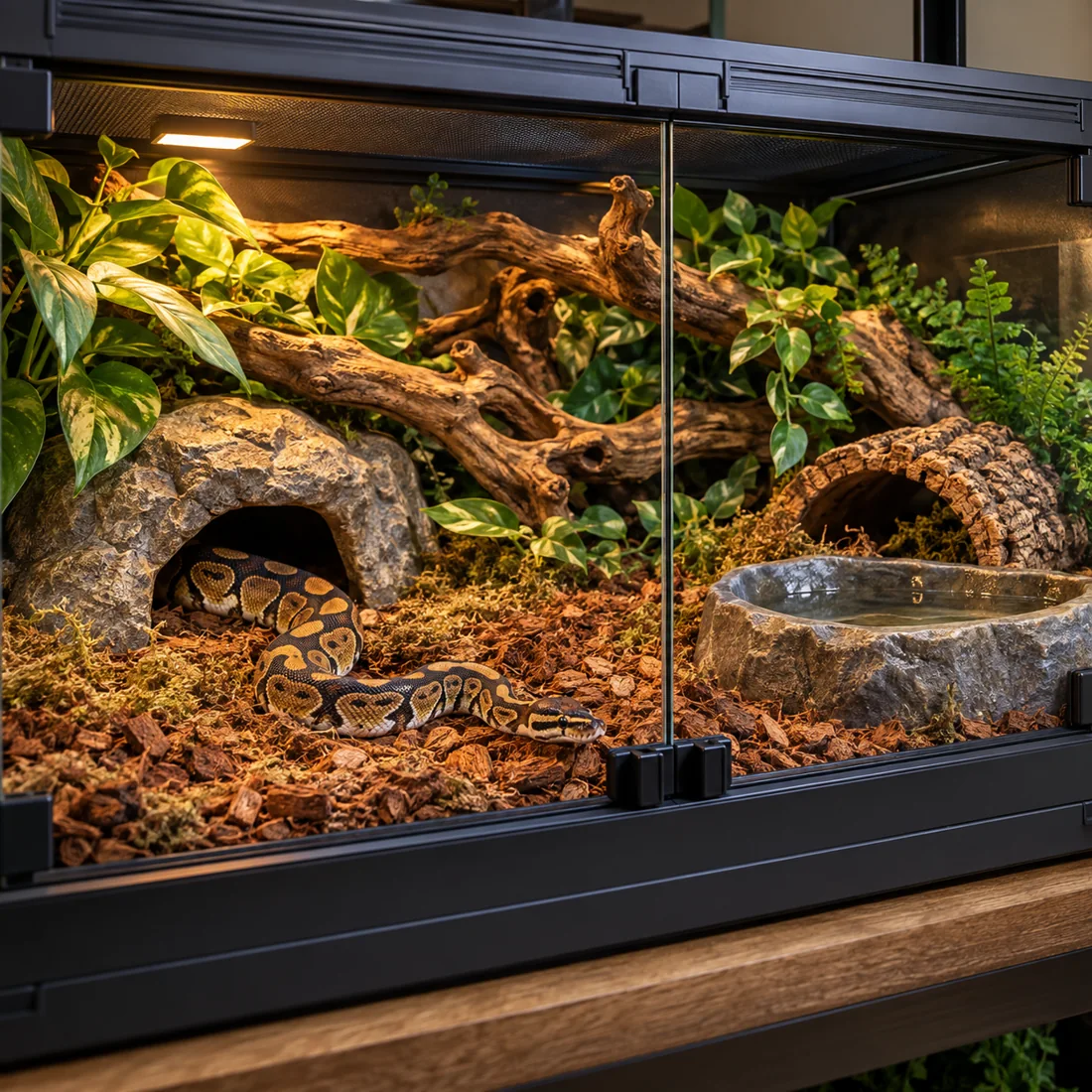
Three adult enclosure routes
Zen Habitats 4×2×2 PVC
Zen currently lists 4×2×2 and larger PVC options and markets the solid-panel design for heat retention and reduced reflections.
Buy it when: you want a finished front-opening system with solid surfaces and modular accessories
Watch for: choose ventilation/lighting so humidity does not become either swampy or too dry
Dubia 4×2×2
ReptiFiles includes Dubia's 4×2×2 among its recommended ball-python enclosure options, making it a strong value baseline.
Buy it when: you want a mainstream 4-foot footprint and can tune humidity with substrate and vent management
Watch for: check current lock/door hardware and add security appropriate for a snake
Kages 4×2×2 PVC
Kages offers multiple screen and vent configurations, useful when you are balancing overhead heat with a humid 60–80% daytime target.
Buy it when: you want screen and vent configuration selected around your heating plan
Watch for: premium price and customization require more planning
Why 4 feet is practical
A ball python needs both a warm hide and a cooler retreat, plus deep moisture-retentive substrate and clutter. A 4-foot enclosure makes it easier to establish those zones without putting the water bowl, hide and heat source on top of each other.
Humidity is not solved by sealing every vent
Current care guidance targets roughly 60–80% daytime humidity with higher nighttime spikes. Deep substrate, appropriate watering/misting and a humid retreat are better tools than turning the enclosure into stagnant wet air.
Heat from above changes enclosure shopping
Current ReptiFiles guidance prefers overhead daytime heat over heat mats as a primary source. That means you need a safe screen or internal guarded fixture strategy. If a bulb must be mounted inside a snake enclosure, a robust guard is mandatory.
UVB is no longer a weird add-on
ReptiFiles notes that current evidence supports UVB as beneficial for snakes and recommends a low-intensity linear T5 HO zone. A 4×2×2 has enough height to create that gradient if you plan lamp distance and climbing décor carefully.
The part that matters more than the product name
Measure the enclosure, not the marketing label
“40 gallon,” “120 gallon,” and similar labels are convenient shorthand, but reptiles experience length, width, height, ventilation and usable surface area. Two tanks with the same nominal volume can create completely different thermal gradients. Before you buy a heater, lamp or enclosure accessory, write down the actual internal dimensions and the distance from the animal’s highest usable basking surface to the lamp.
Build the gradient before adding the animal
A good reptile setup offers choices. The warm end should be meaningfully warmer than the cool end, humidity should be appropriate to the species rather than uniform everywhere, and the animal should be able to move into shade. Run the enclosure empty for several days, log temperatures at animal level, and change wattage, lamp height or ventilation before the reptile moves in.
Use instruments, not your hand
Human skin is a poor reptile thermometer. Use digital probe thermometers for ongoing air or hide measurements and an infrared temperature gun for surfaces. If you are dialing in UVB, lamp output is affected by fixture, mesh and distance; a Solarmeter is the most direct way to measure UVI instead of guessing from a bulb percentage.
Heat must be controlled
Any heat source capable of overheating an enclosure needs appropriate control. On/off thermostats are suitable for certain non-light-producing or supplemental devices such as heat mats; proportional/dimming control is the better match for devices whose output should be modulated smoothly. A thermostat is a safety/control layer, not a substitute for independent thermometers.
How to test the setup after the box arrives
Assemble the hardware with no animal inside. Put the substrate and hardscape in their final positions because a raised basking rock or four inches of substrate changes the distance to the lamps. Run the normal day cycle, then record the warmest surface, warm-side air, cool-side air and humidity. Repeat after the room has had time to cool overnight. If the enclosure sits near a window or exterior wall, repeat during the hottest and coldest part of the day.
Change one variable at a time. Raising a lamp, changing wattage, covering part of a screen or adding ventilation can all affect multiple readings. If you change three things together, you will not know which one solved the problem. Once the enclosure is stable, photograph the probe locations and write down the normal range; that makes it much easier to spot a failed bulb, moved probe or seasonal room change later.
What I would not buy just because it appears in a search result
Skip heat rocks, unregulated heating pads, colored night bulbs, tiny analog stick-on gauges and mystery-brand UVB lamps with no useful output data. Also be skeptical of “all-in-one” reptile kits that pair an undersized tank with reptile carpet and a single bulb. The easiest affiliate link to click is not necessarily the product that creates a viable habitat.
When two products are close, favor the one that is easier to measure, replace and service. Standard bulb sizes, replaceable T5 tubes, accessible probes, removable substrate barriers and available replacement nozzles matter more after a year than flashy packaging on day one.
Before checkout: setup checklist
- Actual enclosure dimensions fit the species and adult size
- Warm and cool zones can both exist at the same time
- Heat source has appropriate thermostat/control
- UVB type, fixture, mesh loss and distance have been considered
- At least two reliable temperature readings are available
- Humidity can be measured digitally at animal level
- Hides/cover are available in more than one thermal zone
- Substrate matches the species rather than pet-store convenience
- All hot bulbs inside enclosures are physically guarded
- Cords, probes and misting lines are secured against the animal
Frequently asked questions
Is 4×2×2 big enough for an adult ball python?
It is a commonly recommended adult baseline and appears in current ReptiFiles enclosure recommendations; larger can be beneficial when properly furnished.
Is PVC better than glass?
PVC is usually easier for heat/humidity retention and visual security, while glass is easier to view and widely available. Both can work with correct ventilation and equipment.
Do ball pythons need a locking enclosure?
They need genuinely secure closure. Use locks or manufacturer hardware appropriate to the door system.
Should I use a heat mat?
A mat can be supplemental, but current guidance favors overhead daytime heat for warming both surfaces and air.
Primary husbandry and manufacturer sources
- ReptiFiles — Ball Python Terrarium Size & Lighting
- ReptiFiles — Ball Python Temperatures & Humidity
- Zen Habitats — Reptile Enclosures
- Kages — 4x2x2 PVC Enclosure
- Dubia.com — 4x2x2 Enclosure Instructions
Affiliate disclosure: ReptileSetup.co may earn from qualifying purchases through Amazon Associates and eBay Partner Network at no additional cost to you. We do not raise or lower a husbandry recommendation to make a product easier to sell.